

Do Vitamin C Serums Deliver Real Benefits Or Just Marketing?
Most Vitamin C serums do not deliver Vitamin C benefits because they don't use the right form of Vitamin C. There is a reason for this and I will explain below.
Here’s the fact the whole industry has quietly built itself around avoiding: L-Ascorbic Acid is the only form of Vitamin C that provides topical Vitamin C benefit. Not one of several. The only one.
If the label doesn't say ascorbic acid, it won't work.
Flip a Vitamin C serum over and read the ingredient list. If the ingredient says ascorbic acid, it can deliver Vitamin C benefit to your skin. If it says anything else — Sodium Ascorbyl Phosphate, Magnesium Ascorbyl Phosphate, Ascorbyl Glucoside, Ethyl Ascorbate, or any of the other names the industry keeps inventing — it can’t.
If it doesn’t say ascorbic acid, it isn’t going to work topically.
Why not? Because the Vitamin C is dead until something frees it.
Stabilized derivatives aren’t Vitamin C molecules. They’re Vitamin C molecules with something else attached — a phosphate, a magnesium salt, a sugar, an ethyl group. The industry calls that attachment “stabilization.” It’s technically accurate. But what stabilization actually means is that the Vitamin C is dead as long as it’s attached. It doesn’t act like Vitamin C. It doesn’t do what Vitamin C does. Not until something cleaves off the attachment and frees the ascorbic acid.
Here’s the part the industry doesn’t want you to think about too hard.
If you ate these stabilized forms, they would work. Your digestive system is designed to break down attachments like this. It would cleave off the phosphate or the sugar, free the ascorbic acid, and deliver Vitamin C to your body just fine.
Your skin can’t do that.
Your skin is not a digestive tract. It doesn’t have the enzymatic machinery to reliably strip off those attachments. Whatever tiny conversion does happen at the skin level is so negligible it might as well be zero. The Vitamin C stays trapped. Attached. Dead. It sits there as a different molecule and does essentially nothing.
That’s the whole trick. The category is selling you Vitamin C forms that would work if you ate your serum — which, of course, you don’t.
So why does the whole category run on stabilized vitamin C derivatives?
Because L-Ascorbic Acid is a pain to work with. It’s one of the hardest ingredients in cosmetic chemistry. It oxidizes on contact with water, light, and air. A serum bottled at 20% L-Ascorbic Acid can degrade to a fraction of that in a few weeks if the formula isn’t built to protect it.
Most brands can’t stabilize it. So they build the formula around the cheaper, easier derivatives — the ones that don’t work on your skin — and some may add a trace of L-Ascorbic Acid so the front of the bottle can say it has L ascorbic acid. But not enough to deliver any real benefit.
That’s the practice. It’s not illegal. It’s not even technically dishonest — the L-Ascorbic Acid is in there. It’s just not doing the work.
You’re paying for the promise of Vitamin C. But in reality, you’re just getting marketing.
What to look for on the label
The next time you’re standing in front of a Vitamin C serum:
Read the ingredient deck. If ascorbic acid appears near the top and it’s the only Vitamin C ingredient in the formula, the formula is built around it. That’s a real Vitamin C serum.
If the deck reads any of the stabilized names — Sodium Ascorbyl Phosphate, Magnesium Ascorbyl Phosphate, Ascorbyl Glucoside, Ethyl Ascorbate — the trapped, inactive form is what you’re paying for. What’s on the front of the bottle isn’t doing the work.
You don’t need a chemistry degree to see it. You just need to know what to look for.
What we do differently
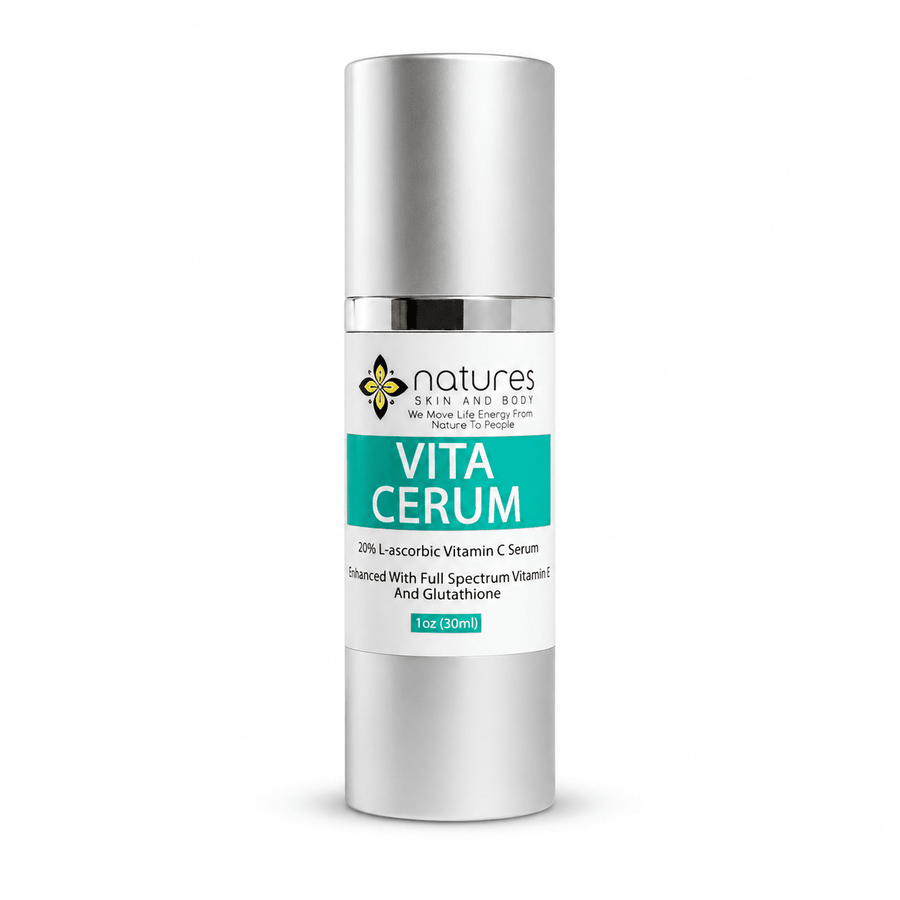
I built VitaCerum™ — our Professional Strength Liposomal Vitamin C Serum — around the problem the rest of the category has been formulating around.
It’s 100% L-Ascorbic Acid at 20% concentration. No derivative fillers. No stabilized substitutes. The Vitamin C on the front of the bottle is the Vitamin C inside the bottle.
The stability problem — the one that made the category run for cover in the first place — I solved mainly with liposomal encapsulation. The L-Ascorbic Acid is protected inside microscopic lipid spheres that shield it from oxidation while it sits in the bottle, and carry it through the skin’s outer barrier when you apply it. Stable in the bottle. Active on the skin. Doing the work it’s supposed to do.
We didn’t start with a formula and figure out how to market it. We started with a criterion: if it doesn’t deliver topical Vitamin C benefit, we don’t sell it.
We sell results not marketing hype.